
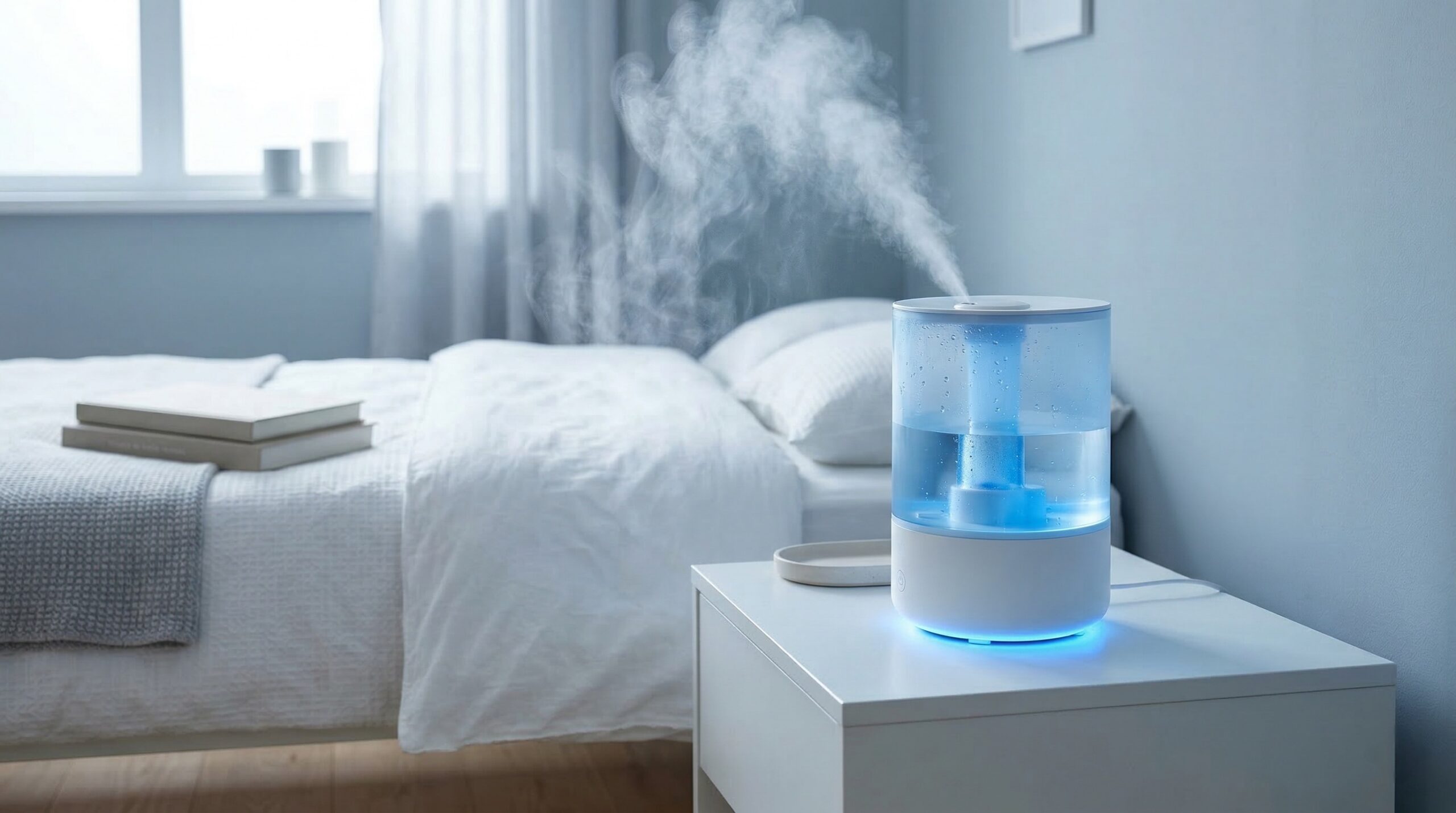
TL;DR
A cool-mist humidifier can help a dry, irritated cough feel less “scratchy” at night—as long as you keep your room’s humidity in a safe comfort range (about 30–50%) and keep the unit clean and dry between uses. For most shoppers, the best choice is the one that runs quietly all night in your room size and is easy enough to clean that you’ll actually maintain it.
What a Cool Mist Humidifier for Cough Actually Is
A “cool mist humidifier for cough” isn’t a special medical device — it’s a regular humidifier used for a specific goal: adding moisture to dry indoor air so your throat and upper airways don’t get as irritated overnight. When your home air is dry (common in winter heating season, or in arid climates), your nasal passages and throat can dry out, which can make you feel tickly and trigger more coughing — especially when you’re trying to sleep.
Most cool-mist units you’ll see are ultrasonic (they vibrate water into a fine mist) or evaporative (a fan blows air through a wet wick/filter so water evaporates). Either approach can add moisture; the practical differences for cough-focused shoppers usually come down to:
- Noise: Ultrasonic humidifiers tend to be quieter, which matters when a cough already disrupts sleep.
- Minerals / “white dust”: Ultrasonic units can spray tiny mineral particles into the air if you use hard tap water. That residue can settle as “white dust” on surfaces — and in sensitive households, you generally want to minimize airborne particulates. Using distilled or demineralized water is the simplest fix.
- Ongoing maintenance: Any humidifier can grow slime/biofilm and microbes if water sits and the unit isn’t cleaned. This is the biggest “it helped my cough” vs “it made things worse” dividing line in real homes.
The other key concept is humidity control. More humidity is not automatically better. Evidence-based indoor-air guidance generally points toward keeping indoor relative humidity in a moderate band (often around 30–50%). Too high and you increase the risk of moisture problems (including mold) and dust mites — both of which can aggravate allergies and asthma and make coughing worse. If you want the most safety guardrails, use a separate hygrometer (cheap and effective) and adjust the humidifier so you stay in range; for mold/moisture context, the EPA mold and moisture guide is a solid reference.
Finally, for kids’ rooms, cool mist is generally preferred over warm mist because it avoids the burn/scald risk of hot water or steam. (If your child has persistent or severe cough, or any breathing distress, it’s worth checking in with a pediatrician — humidifiers are comfort tools, not treatment for serious illness.)
Who a Cool Mist Humidifier for Cough Fits Best
A cool-mist humidifier is usually a good fit if you’re dealing with a cough that feels worse at night because the air is dry—not because of uncontrolled humidity, allergens, or an underlying condition that needs medical care. Here are the scenarios where we see humidifiers help most, based on common indoor-air best practices and what owners tend to report.
- You wake up with a dry throat or “sandpapery” nose during heating season, and your bedroom humidity is low (often under ~30%). In that case, bringing humidity into a moderate range can reduce irritation that triggers coughing.
- You need quiet, overnight runtime. If your cough is already interrupting sleep, a loud unit or one that runs dry at 3 a.m. is a bad match.
- You’re willing to measure humidity. A $10–$20 hygrometer is one of the best “accessories” you can buy with a humidifier. It helps you avoid overshooting into the damp zone.
- You can commit to routine cleaning and drying. Humidifiers are not “set and forget.” If you won’t empty, rinse/wipe, and regularly clean, you’re better off skipping it.
- You’re shopping for a child’s room and want cool-mist safety. Cool mist removes the burn risk that comes with heated-water units.
One example of the “runs hard and keeps up” experience shows up in verified owner feedback for a popular cool-mist ultrasonic unit: “My wife and I live in a 2,000 square foot apartment and have had this humidifier running full blast for 24 hours a day for almost a week and it works great!!” — verified buyer, 5 stars.
If you’re not sure whether dryness is your issue, don’t guess — measure. If you’re already near (or above) the mid-range and still coughing, adding more humidity may not help and could create new problems.
Who Should Skip a Cool Mist Humidifier for Cough
Humidifiers can backfire when humidity gets too high or the device isn’t maintained. You should consider skipping (or at least pausing) humidifier use if any of these apply:
- Your room is already humid (frequent window condensation, musty smells, damp-feeling bedding, or hygrometer readings consistently above ~50%). In this case, adding moisture can encourage mold and dust mites — common cough and allergy triggers. If you suspect mold, start with moisture control and guidance like the CDC mold cleanup guidance.
- You’re unlikely to clean it. Dirty humidifiers can disperse microbes and gunk into the air. If you know you won’t keep up with cleaning, you may be better off focusing on hydration, nasal saline, or other clinician-recommended comfort steps.
- You have asthma/allergies that flare with humidity. Some households do better at the lower end of the range, and you may want input from a certified IAQ professional or a board-certified pulmonologist if symptoms are persistent.
- You’re expecting guaranteed “health benefits.” A humidifier can make you feel more comfortable, but it’s not a cure for cough causes like infection, reflux, post-nasal drip, smoke exposure, or uncontrolled allergies.
It’s also worth noting that not everyone feels a clear breathing improvement from a given unit. A verified buyer put it bluntly: “the mist generated does not seem to have any health benefits for better breathing” — verified buyer, 2 stars.
If you’re coughing hard, wheezing, short of breath, coughing up blood, or a cough is lingering, a humidifier shouldn’t be the main plan — talk with a clinician to rule out something more serious.
Price and Value
For cool-mist humidifiers suitable for cough comfort, pricing usually clusters into a few buckets:
- Budget: Smaller bedside units that may not last all night on higher settings, and sometimes have more fiddly cleaning.
- Midrange: Larger tanks and better overnight runtime, often the sweet spot for bedrooms and nurseries.
- Premium: More automation (humidistat/auto mode), sometimes easier cleaning designs, and occasionally higher output for larger spaces.
For the specific model we’re drawing on here, the Vicks Filter-Free Ultrasonic Humidifier 1.2 Gal is typically in the $50–$75 range. That’s a common “value” zone because you’re paying for a larger tank (better odds it runs through the night) without committing to recurring filter purchases.
That said, “filter-free” doesn’t mean “maintenance-free.” You may save on replacement wicks/filters, but you still need to budget time (and possibly distilled water or demineralization) to keep it from turning into a mineral- and biofilm-holding container.
If you’re in a hard-water area, the long-term value calculation should include water strategy. Using distilled water costs more upfront, but it can reduce white dust and make cleaning easier. If you won’t do distilled, you’ll want some plan to keep mineral scale under control.
Common Mistakes When Trying a Cool Mist Humidifier for Cough
Most “humidifiers didn’t help” stories trace back to a handful of avoidable mistakes. Here’s what we see most often in user reviews and what indoor-air guidance suggests.
- Not measuring humidity (and accidentally over-humidifying). People run a humidifier “full blast” and assume it’s fine. In a closed bedroom, that can push humidity high enough to cause window condensation and feed dust mites/mold — making cough/allergies worse.
- Using hard tap water in an ultrasonic unit. This often leads to “white dust” on furniture and potentially more particulate in the air. Distilled/demineralized water is the simplest way to reduce mineral aerosolization; the EPA humidifier use and care guidance discusses minerals and maintenance concerns.
- Letting water sit in the tank/base. Stagnant water plus warmth from a motor is a recipe for biofilm. Even if you don’t see slime, it can build up fast.
- Putting the humidifier too close to bedding or walls. If mist is landing directly on a comforter, carpet, or drywall, you’re creating damp surfaces — again increasing the chance of mold/mildew issues.
- Assuming “filter-free” means “no cleaning needed.” It doesn’t. You still need regular cleaning and thorough drying.
- Expecting instant cough “treatment.” Comfort can be real, but it’s not a medication. If a cough is from smoke exposure, asthma, reflux, or illness, humidity may be only a small part of the picture.
We also see some owners running units essentially nonstop in large spaces, hoping for whole-apartment results. One verified buyer reported: “My wife and I live in a 2,000 square foot apartment and have had this humidifier running full blast for 24 hours a day for almost a week and it works great!!” — verified buyer, 5 stars. That might be fine in a dry climate with measured humidity — but for many homes, “full blast 24/7” is exactly how you end up over-humidifying. Use a hygrometer and adjust output to what your room actually needs.
FAQ
What humidity level is best for a cough at night?
Aim for a moderate indoor relative humidity — often around 30–50%. Many people feel less throat and nasal dryness in that range, which can reduce cough irritation at night. If you see condensation on windows or notice damp smells, back off output and re-check your readings.
Can a humidifier make coughing worse?
Yes. If humidity gets too high, you can increase mold and dust mites — common triggers for coughing in allergy/asthma households. And if the humidifier is dirty, it can disperse microbes or biofilm into the air. If you suspect moisture problems, start with moisture control and references like the EPA mold and moisture guide.
Is cool mist better than warm mist for kids?
Generally, yes. Cool mist avoids the burn/scald risk associated with warm-mist vaporizers or heated-water units, which is why pediatric guidance commonly leans cool mist for children’s rooms. You still need to keep humidity in range and keep the unit clean.
Do I need distilled water in a cool mist humidifier?
If you have hard tap water and you’re using an ultrasonic humidifier, distilled (or otherwise demineralized) water is strongly worth considering to reduce mineral “white dust.” If distilled water isn’t practical, you’ll need a mineral-management plan (like a demineralization cartridge if your model supports it) and more frequent descaling/cleaning.
How often should I clean a humidifier I’m using for cough relief?
Clean it often enough that water never sits long enough to grow slime/biofilm. In practical terms: empty out leftover water routinely, wipe/dry accessible surfaces, and do deeper cleaning on a consistent schedule based on the manufacturer’s instructions. For health and maintenance considerations, see EPA humidifier use and care.
Where should I place a cool mist humidifier in a bedroom?
Place it where the mist won’t wet bedding, carpet, or walls — typically on a stable surface a few feet away from the bed and not directly under shelves or near electronics. If you notice damp spots or condensation near the unit, move it farther away and lower the output.
Should I run a humidifier all night when I have a cough?
If your room is dry and you can keep humidity in the target range, running it through your sleep window can help maintain comfort. The key is control: use a hygrometer, start on a lower setting, and avoid overshooting into high humidity overnight.
Looking for these on Amazon? Browse cool mist humidifier for cough on Amazon →
Bottom Line
A cool-mist humidifier can be a solid comfort tool for a nighttime cough when dryness is the trigger — especially if it’s quiet, lasts all night, and you keep humidity around 30–50% with a hygrometer. The biggest deal-breakers are over-humidifying and poor cleaning habits, so pick a model and routine you can realistically maintain.
Affiliate disclosure: This article contains affiliate links. We earn a small commission at no extra cost to you.