
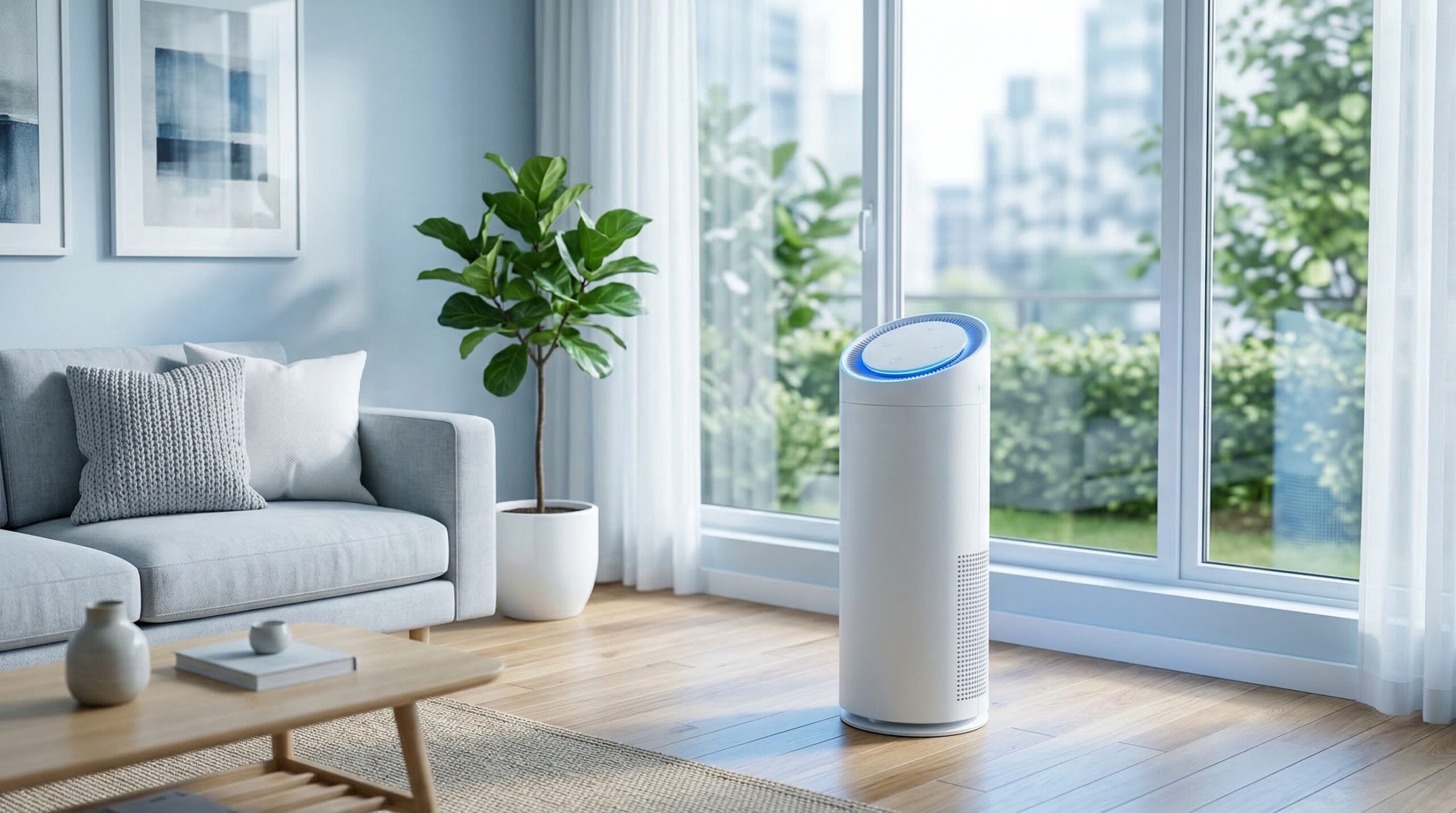
TL;DR
For a small apartment, the “best” air purifier is the one you’ll actually run on a meaningful fan speed — which usually means matching CADR to your main room and keeping noise tolerable on medium/high. Focus on true-HEPA filtration (or equivalent), reasonable filter costs, and smart placement with clear airflow; skip ionizer/plasma-style extras unless they can be disabled.
Top Recommended Air Purifiers
| Product | Best For | Price | Pros/Cons | Visit |
|---|---|---|---|---|
| Alen | Store Alen BreatheSmart 45i Certified Refurbished Air Purifier | Main living area in a small apartment | $220 – $250 | Refurb pricing can save money; availability and condition can vary vs new | Visit Alen |
| Blueair Mini Restful™ Sunrise Clock Air Purifier in Coastal Beige | Nightstand/bedside use in tight spaces | $110 – $130 | Very compact for bedrooms; buyer reports flag frustrating subscription/customer support experiences | Visit Blueair |
Top Pick: Best Overall Air Purifier for a Small Apartment
Alen | Store Alen BreatheSmart 45i Certified Refurbished Air Purifier
Best for: A typical small apartment where you want one “do-it-most” purifier for the main living/sleeping space (for example, a 350–600 sq ft open-plan living room/bedroom area) without paying full price for new.
The Good
- Certified refurbished option can cut upfront cost while still getting a full-size apartment-oriented unit.
- Better fit than ultra-mini units when you’re trying to clean the air in a main room — not just the air right next to your bed.
- From a brand that focuses specifically on air purifiers (helpful when you’re comparing filter availability and long-term support).
- Practical choice for renters: one unit can often cover the space where you spend most of your time, which matters more than trying to “cover the whole apartment” on paper.
The Bad
- Refurb inventory can be inconsistent, so the exact color/finish and availability may change.
- You still need to budget for ongoing filter replacements (the real long-term cost in a small apartment where you’ll run it daily).
- Like any larger purifier, placement matters — if it’s tucked behind a couch, you’ll give up performance.
Our Take: If you want one purifier that can realistically move enough air for a small apartment’s main room (instead of relying on “sleep mode” marketing), the refurbished 45i is the most sensible balance of coverage and cost in this shortlist.
Blueair Mini Restful™ Sunrise Clock Air Purifier in Coastal Beige
Best for: A very small bedroom setup — like a tight studio layout where you need something that fits on a nightstand, and you mainly want localized air cleaning near the bed.
The Good
- Compact footprint that’s easy to place in small apartments with limited floor space.
- Designed around bedside use (small-room intent, not a big tower you have to park in a walkway).
- Lower upfront cost than many full-size purifiers, which can help if you’re prioritizing a bedroom unit first.
The Bad
- Buyer reports suggest customer service and subscription management can be frustrating, which matters if filters are tied to an auto-ship plan.
- As a mini unit, it’s not the right choice if you expect one purifier to handle a larger open-plan living room on higher-ACH performance.
1.6/5 across 83 Trustpilot reviews (source)
“I just spent 3 days interacting with BlueAir and their awful ZenDesk AI for an air filter subscription problem. I was trying to cancel an existing subscription that would be…” — Trustpilot review
Price: $110 – $130
Our Take: This is best treated as a space-saving bedside purifier — just go in with realistic expectations about coverage, and consider buyer feedback around filter subscriptions before you commit.
FAQ
How do I size an air purifier for a small apartment?
Use CADR (Clean Air Delivery Rate) as your shortcut: you generally want enough airflow to hit about 4–5 air changes per hour (ACH) in the room you care about most (often the main room or where you sleep). EPA explains CADR and practical selection factors in its Air Cleaners and Air Filters in the Home guidance, and AHAM outlines how CADR is standardized in the AHAM Verifide program.
Is a quiet “sleep mode” enough to clean the air in a studio?
Often not. Many purifiers are whisper-quiet on sleep mode, but they also move much less air on that setting — which can mean you’re not getting meaningful particle removal unless you run medium/high for part of the day. If you’re noise-sensitive, prioritize a model you can tolerate on the fan speeds that actually deliver cleaning performance (and consider running high for 30–60 minutes, then backing down).
What’s the biggest mistake people make with air purifiers in small apartments?
Undersizing and poor placement. If the unit can’t move enough air for the room (CADR too low), you’ll see disappointing results — and if you stick it behind furniture or in a corner, you can choke off airflow and reduce mixing of cleaned air. Keep the intake and exhaust clear and give it a few feet of breathing room when possible.
Do I need a true HEPA filter for allergies and fine dust?
If allergies, wildfire smoke, or fine dust are your main concern, a true-HEPA (or equivalent high-efficiency particle filter) is usually the safer bet than “odor-only” filters or gimmicky add-ons. For definitions and practical advice on home filtration, it’s worth reading the EPA’s overview in Air Cleaners and Air Filters in the Home.
Should I avoid ionizers or “plasma” features in an air purifier?
Be cautious. Some devices marketed with ionizers or similar tech can produce ozone or other byproducts, and those features don’t replace moving a lot of air through a strong particle filter. If a purifier includes ionization, look for clear documentation that it can be turned off, and consider checking whether the model is listed by CARB on its CARB-certified air cleaning devices list.
How much should I expect to spend on filters each year?
It varies a lot by model and how hard you run it, but filters are commonly the biggest ongoing cost — especially in small apartments where you may run the purifier most of the day. Before you buy, look up the replacement filter price and the recommended interval, then estimate yearly cost (filter price × replacements per year). If odors are a big issue, remember that carbon can saturate faster with frequent cooking.
Where should I put an air purifier in a small apartment?
Put it where air can circulate freely: away from corners, not wedged between a couch and the wall, and not blocked by curtains. In an open-plan apartment, place it in the “main airflow path” of the space — for example, near the living area but not hidden under a desk — so cleaned air can mix throughout the room. If you have asthma or other respiratory concerns, it’s also reasonable to run placement ideas by a certified IAQ professional or a NATE-certified HVAC contractor (especially if you’re also troubleshooting ventilation and humidity).
Looking for these on Amazon? Browse best air purifier for small apartment on Amazon →
Bottom Line
The best air purifier for a small apartment is the one sized to your main room’s needs (think CADR and realistic ACH) that you can stand to run on effective fan speeds. From this shortlist, the Alen BreatheSmart 45i Certified Refurbished model is our top pick because it’s positioned as a more capable “main room” purifier while keeping upfront cost lower than buying new.
Affiliate disclosure: This article contains affiliate links. We earn a small commission at no extra cost to you.