
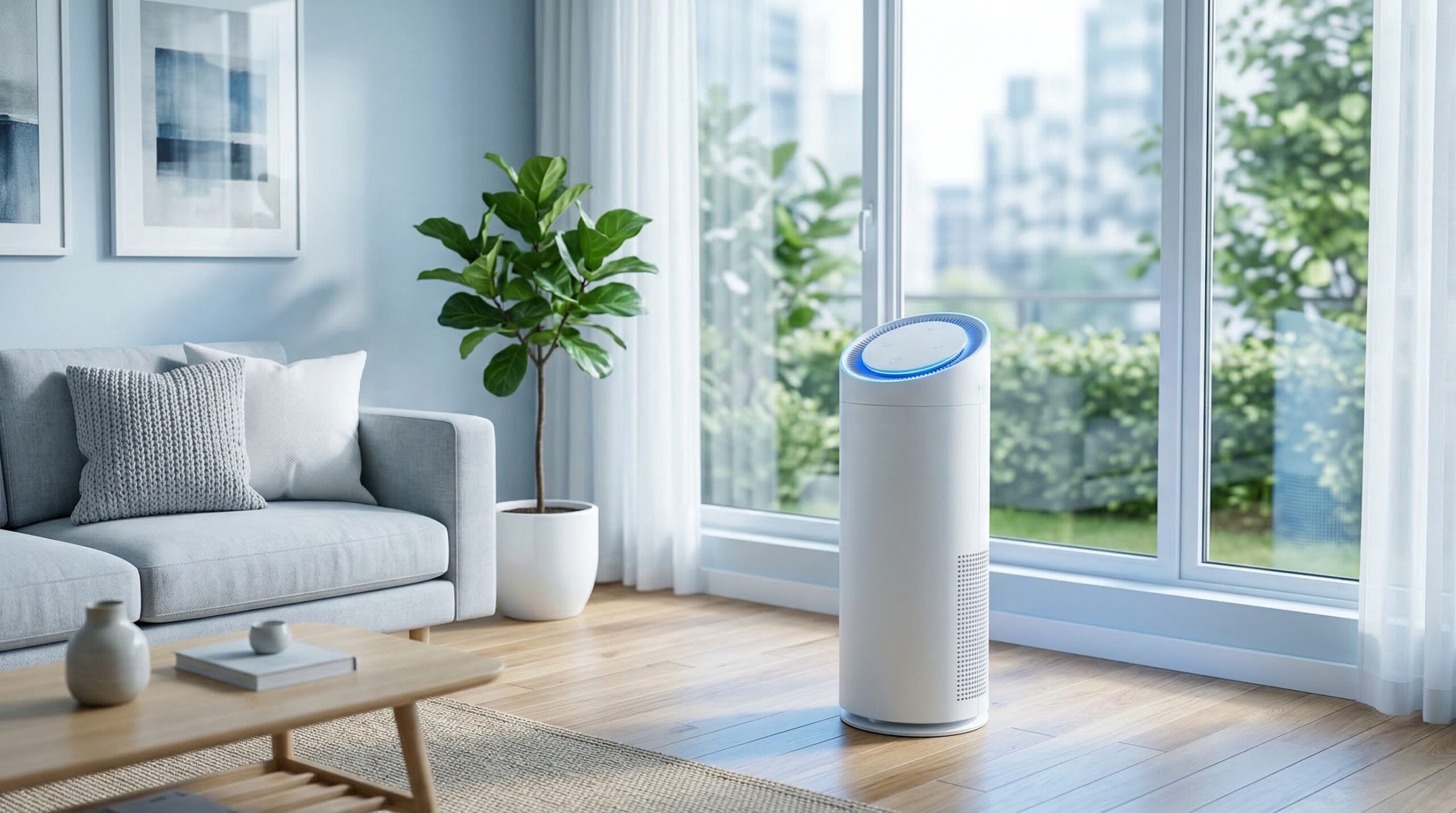
TL;DR
For most garages, you’ll get the best results from a high-airflow True HEPA purifier with a sturdy pre-filter you can clean often, since garage dust loads filters fast and open doors/drafts dilute performance. If your main problem is odors or fumes (paint, fuel smells, exhaust), prioritize a model built for heavier gas/odor adsorption — and remember filtration is not a substitute for ventilation/source control for hazardous fumes.
Top Recommended Air Purifiers
| Product | Best For | Price | Pros/Cons | Visit |
|---|---|---|---|---|
| KNKA Air Purifier APH4000 Up to 1,695 Ft² in 1 Hr | General garage dust in medium-to-large spaces | Check price on Amazon | Simple setup with strong perceived cleanup; limited long-term ownership track record | Visit Amazon |
| Austin Air HealthMate Plus Air Purifier Model B450 | Smoke/odor-prone garages (with noise tolerance) | Check price on Amazon | Owners note odor/smoke reduction; very loud for some and pricey up front | Visit Amazon |
| Amazon Renewed Shark HP152 Air Purifier with Filter | Lower-maintenance filtering in a small garage bay | Check price on Amazon | Auto-sensing convenience and good early satisfaction; renewed condition can vary and high speed can be noisy | Visit Amazon |
Quick sizing cheat (garage reality check): Ignore the biggest “covers X sq ft” number on the box and size for airflow (CADR) and air changes per hour (ACH). For light storage, a few ACH can help; for an active workshop (sanding, sweeping, pulling a car in/out), you typically need higher airflow and you’ll run medium-to-high fan speeds more often (more noise, more filter upkeep).
Top Pick: Best Overall Air Purifier for a Garage
KNKA Air Purifier APH4000 Up to 1,695 Ft² in 1 Hr
Best for: Most typical one- or two-car garages where you want broadly better air day-to-day (road dust, cardboard/box dust, seasonal pollen blown in) and quick cleanups after sweeping or light DIY work.
The Good
- Easy to get running fast — helpful when you just want “turn it on and forget it” coverage for a dusty garage corner or workbench zone.
- Strong early buyer reports on responsiveness in auto mode, which can be handy when your garage air changes suddenly (door opens, car pulls in, you kick up dust).
- Good value positioning for larger-area claims, which can matter in garages that are simply bigger (and leakier) than living spaces.
- Approachable choice if you expect to run higher fan speeds for an hour or two after messy tasks (noise is easier to tolerate in a garage than a bedroom).
The Bad
- Limited long-term ownership data compared with established “legacy” brands, so it’s harder to predict filter availability and performance consistency over years.
- Auto/timer behavior may not match everyone’s preference (some people want more control over always-on operation).
4.7/5 across 2,072 Amazon reviews
“This is such a great machine. It’s quiet, it blows clean air, it’s easy to use, and the lights are not too bright. My mom lives in an old apartment with swamp coolers instead of a/c. It always smelled dank and musty, and it aggravated her cough. After just a few days of using this machine with it reaching green air levels, it’s not as musty in her apartment…” — Verified Amazon buyer (5 stars)
“So far so good, as I have only had it about 3 weeks. I wish it could be set for 24 hours on & then just automatically shut off when the air is good. i may give another review after I have used it for a few months.” — Verified Amazon buyer (4 stars)
“I leave her on auto, and the second someone enters my home with air quality issues, this little psychopath reacts like she just caught a personal insult.” — verified buyer, 5 stars
Our Take: If you want one reasonably priced purifier to dedicate to a garage and actually run at meaningful fan speeds, this is the most straightforward “start here” pick — just plan on more frequent pre-filter cleaning and filter changes than you’d expect indoors.
Austin Air HealthMate Plus Air Purifier Model B450
Best for: A garage that deals with stubborn odors/smoke intrusion (for example, a workshop area that regularly smells like combustion, lingering smoke, or strong “garage” odors), where you can tolerate a loud high setting.
The Good
- Buyer reports often highlight noticeable odor and smoke reduction, which is the main reason to consider it for a garage vs. a basic HEPA box.
- Heavy-duty “appliance” feel that suits garage life better than delicate, low-profile bedroom purifiers.
- A strong fit when you want to run a unit hard for a “clear-out” session after a smoky or smelly event (then turn it down later).
- Premium build-class perception from owners who prioritize durability over sleek features.
The Bad
- Noise can be a deal-breaker on higher speeds, especially if your garage shares a wall with living space.
- High upfront cost compared with most consumer air purifiers.
4.5/5 across 197 Amazon reviews
“I have a nice apartment, and my neighbor has a heavy pot smoking habit. This machine (cranked on high) will remove 90% + of pot smell leeching into my space. In my case, the smoke smell was seeping through the wall that divides our units. My neighbor does not share any ventilation ducts with me and is completely walled off. I tried (2) other Levoit air…” — Verified Amazon buyer (5 stars)
“Extremely loud. There’s no way any can realistically use this in a modern apartment.” — Verified Amazon buyer (1 stars)
Our Take: If odors/smoke are your main garage complaint and you’re willing to pay for a more heavy-duty approach, this is a compelling option — but go in expecting to manage noise (especially on “high”).
Amazon Renewed Shark HP152 Air Purifier with Filter
Best for: A smaller garage bay or workshop nook (like a workbench area) where you want auto-sensing convenience and you’re comfortable buying renewed to save money.
The Good
- Auto mode that ramps fan speed up/down as air quality changes — useful when garage conditions swing quickly with door openings and dust bursts.
- Buyer reports mention satisfaction with perceived filter longevity, which can matter in a garage where filters otherwise get expensive fast.
- Good pick when you want “set it and monitor it” behavior rather than manually changing speeds all the time.
- Renewed pricing can make it a more realistic “dedicated garage unit” without spending premium-brand money.
The Bad
- High setting can be noisy, and garages often require higher speeds to make a real dent in airborne dust.
- Being Amazon Renewed, unit condition and included accessories can vary by listing — inspect it promptly and confirm filter status.
4.6/5 across 56 Amazon reviews
“This unit works great for large to medium size rooms. Very quite and is consistently filtering the air, has made a difference in the amount of dust in the room. When air quality is at 100% the unit kicks into economy mode to save on electricity.” — Verified Amazon buyer (5 stars)
“Happy with how it works so far. Kinda neat to watch the air quality change for different things. When on auto setting (like in video) as air quality changes so does the fan settings. I find the high setting pretty noisy so I tend to set to med or low and just leave it. May take a little longer to clean air, but honestly pretty quick! Only thing Im truly…” — Verified Amazon buyer (4 stars)
“When on auto setting (like in video) as air quality changes so does the fan settings. I find the high setting pretty noisy so I tend to set to med or low” — verified buyer, 4 stars
Our Take: For a small-to-medium garage zone where you want decent filtration without fuss, this renewed Shark can be a smart value — just be realistic that “quiet” and “fast cleanup” rarely happen at the same time in a garage.
FAQ
What CADR do I need for my garage size?
CADR (Clean Air Delivery Rate) is one of the most useful apples-to-apples airflow metrics for particle removal, and it’s typically more trustworthy for sizing than broad “coverage” claims. A practical method is: estimate your garage volume (sq ft × ceiling height), pick a target ACH (air changes per hour) based on how you use the space, and then choose a purifier with enough CADR to get you there at a fan speed you’ll actually run. For background on CADR and why it matters, see AHAM’s CADR overview.
Should I size an air purifier based on “coverage area” on the box?
Not for a garage. Garages are typically draftier than interior rooms (gaps, door seals, frequent door opening), and that dilutes performance — so you generally want more airflow than the marketing number suggests. When available, prioritize CADR (especially smoke CADR) and plan on running medium-to-high speeds during and after dusty tasks.
Will a HEPA air purifier remove car exhaust, paint fumes, or gasoline smells?
HEPA filtration targets particles (dust, smoke particulates, pollen), not gases. For fumes/odors (VOCs), you generally need an activated carbon or other adsorbent stage — and even then, filtration may be limited for heavy or continuous fume generation. For safety and health, source control and ventilation are key for exhaust and solvent fumes; guidance from occupational/public health bodies like NIOSH (CDC) reinforces ventilation as a primary control for airborne contaminants.
Are ionizers or ozone generators a good idea in a garage?
We’d avoid ozone-generating “air cleaners” for occupied spaces; ozone can irritate the lungs and isn’t considered a safe general air-cleaning strategy. If you’re shopping for a garage purifier, it’s safer to stick with mechanical filtration (HEPA + pre-filter) and treat any optional “ion” features with skepticism unless you can disable them. The EPA guide to air cleaners in the home is a solid starting point on filtration and ozone cautions.
How often will I need to replace filters in a garage?
Usually more often than in a bedroom or living room, because garages have heavier particle loads (road grit, sawdust, blown-in pollen) and more air exchange with the outdoors. A good routine is to clean/vacuum the pre-filter frequently (weekly isn’t crazy for an active shop), then watch for signs of loading: reduced airflow, dust settling faster again, or odors lingering. If you want a plan tailored to your garage setup, an HVAC contractor (NATE-certified) or a certified IAQ professional can help you choose a realistic maintenance cadence.
Is it safe to run an air purifier in a hot or unheated garage?
It depends on the unit’s rated operating temperature/humidity range (check the manufacturer’s guidance). Garages can see bigger swings than indoor rooms, and extreme heat/cold can affect plastics, electronics, and sensor accuracy. If you routinely see very hot summers or freezing winters, consider running the purifier only when conditions are within spec, and keep it away from water intrusion and direct exposure to vehicle exhaust streams.
Should I buy one big air purifier or two smaller ones for a garage?
Two units can sometimes work better in a long, narrow, or cluttered garage because you can improve circulation and reduce “dead zones” behind shelves and tool benches. One larger unit can be simpler if you have a clear placement location with good airflow. If your garage door is frequently open, even multiple purifiers may struggle — at that point, ventilation strategy and dust capture at the source matter as much as (or more than) purifier sizing.
Bottom Line
The KNKA APH4000 is our best overall pick for most garages because it’s an easy, good-value way to get meaningful day-to-day particle cleanup — especially if you’ll actually run it at higher fan speeds after sweeping or light DIY work. If odors/smoke are the priority and you can tolerate noise and cost, the Austin Air HealthMate Plus is the heavy-duty alternative. No matter what you choose, size for CADR/ACH, keep the pre-filter clean, and treat filtration as one layer alongside source control and ventilation.
Affiliate disclosure: This article contains affiliate links. We earn a small commission at no extra cost to you.