
TL;DR
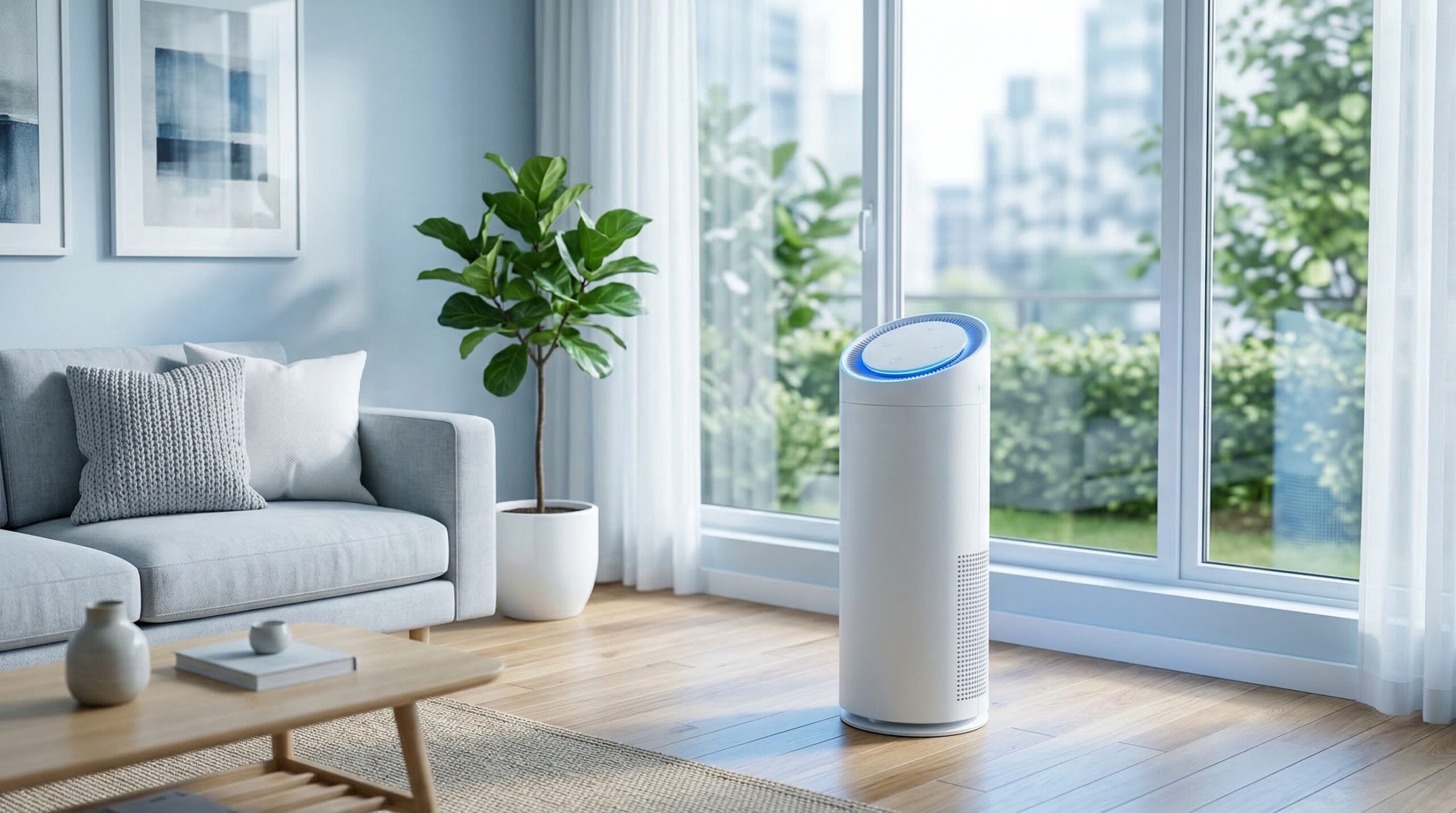
A True HEPA air purifier can help reduce airborne mold spores in the room you’re using most, but it won’t remove mold that’s growing on surfaces or inside walls. For mold, sizing by real airflow (think CADR/ACH) and keeping up with filter maintenance usually matters more than big “covers X sq ft” marketing claims.
Top Recommended Air Purifiers
| Product | Best For | Price | Pros/Cons | Visit |
|---|---|---|---|---|
| NuWave OxyPure Smart Air Purifier | Larger rooms and stronger airflow | Check price on Amazon | Strong cleaning and easy to roll room-to-room; app/pairing can frustrate some users | Visit Amazon |
| Clorox Turbo Air Purifier for Home True HEPA Filter | Budget-focused mold/spore reduction in a smaller room | Check price on Amazon | True HEPA claim at a low price; lacks built-in air quality sensor | Visit Amazon |
Quick sizing note (ACH & mold): A practical target for mold/spores is ~4–6+ air changes per hour (ACH) in the room you’re treating. A simple estimator is: ACH ≈ CADR × 60 / room volume (room volume = length × width × ceiling height). If a purifier doesn’t publish AHAM-verified CADR, treat room-size claims as rough guidance and consider oversizing.
Important reality check: Per guidance from institutions like the U.S. EPA’s mold resources and the CDC’s mold information, you still need to fix moisture and remove/remediate active growth. Air purifiers are exposure-reduction tools, not mold removal.
Top Pick: Best Overall Air Purifiers
NuWave OxyPure Smart Air Purifier
Best for: A primary living area or open basement rec room where you want higher airflow to continuously pull down airborne spores — without having to run on the loudest setting all day.
The Good
- Buyer reports consistently point to strong day-to-day cleaning for dust and musty “stale air,” which is the kind of environment where airborne spores tend to be a concern.
- Easy to move between rooms thanks to wheels — helpful if you’re rotating coverage between a bedroom at night and a living room during the day.
- Several user reviews describe it as quiet for the amount of air it moves, which matters because mold-focused use typically means long run-times, not occasional “turbo” bursts.
- Airflow path/design is a highlight in owner feedback (intake low, exhaust up), which can help mix and cycle room air when placed with good clearance.
The Bad
- Higher upfront price than many True HEPA purifiers, so it’s best when you’ll actually use the extra output (larger rooms, higher ceilings, or ongoing exposure concerns).
- App/smart setup isn’t a sure thing — at least one verified owner report mentions difficulty pairing.
- Like most purifiers, it won’t solve the moisture source (leaks, wet crawlspace, high RH) that’s feeding mold growth.
4.5/5 across 2,638 Amazon reviews
“These Nuwave Whole House filters are wonderful. Their design is perfect, drawing the air from ground level and powerfully expelling it through the top aimed upwards. We like the way it filters and cleans dust and odor so well, we invested in a second one. They are big, but do a big job! And moving them is a breeze with the wheels. When they are at maximum…” — Verified Amazon buyer (5 stars)
“It seems to do a good job and is reasonably quiet even on high speed. Has a lot of nice features. I understand there’s a common problem in pairing it to your phone. I have tried numerous times with NuWave employees to get it paired with no results For $600.00, I’m not a very happy camper. Would not recommend it, because of the inability to get it paired…” — Verified Amazon buyer (4 stars)
“Their design is perfect, drawing the air from ground level and powerfully expelling it through the top aimed upwards.” — verified buyer, 5 stars
Our Take: If you’re trying to meaningfully reduce airborne mold spores in a larger “main” room (or you want to oversize so you can run a quieter fan speed), the OxyPure is the most convincing pick here based on buyer-reported performance and livability.
Clorox Turbo Air Purifier for Home True HEPA Filter
Best for: A smaller bedroom, home office, or nursery where you want a lower-cost way to filter airborne spores and allergy-trigger particles while you work on humidity control.
The Good
- Budget-friendly pricing for a purifier that claims True HEPA filtration — a practical entry point if you need coverage in one targeted room.
- Buyer reports mention symptom relief for allergies, which often overlap with mold sensitivity (though symptom causes can vary person to person).
- Good value when discounted, making it easier to run continuously (rather than “saving” filter life by running it only sometimes).
- Simple purchase choice if you’re prioritizing mechanical filtration over add-ons like ionizers or “air sanitizer” marketing.
The Bad
- No built-in air quality sensor, per verified owner feedback — you’ll need to choose fan speed based on noise tolerance and your mold-risk periods.
- At this price tier, don’t expect substantial activated carbon for stubborn musty odors; it’s mainly about particle capture.
- For mold-focused results, you may need to run it at a higher (noisier) speed to hit strong ACH in the room.
4.5/5 across 207 Amazon reviews
“My First Air purifier make note before readingI really enjoy getting this as my first air purifier i got it because I was having allergies for over a week straight and waking up with" Flem" in my throat 2 days I wake up a lot better with no flem or irritating symptoms I also got this particular purifier because if the Name Brand and it was actually…” — Verified Amazon buyer (5 stars)
“Good air purifier on sale for prime days, a little loud on max speed if you’re nearby, good true hepa filtration compared to other non hepa options aka "proprietary filter", wish it had built in sensor, but for the price, awesome!” — Verified Amazon buyer (4 stars)
“wish it had built in sensor, but for the price, awesome!” — verified buyer, 4 stars
Our Take: If you need an affordable True HEPA-style purifier for a single smaller room — like a 10×12 bedroom with an 8 ft ceiling — this Clorox model is a sensible, value-first choice, as long as you’re okay managing fan speed manually.
FAQ
Will a HEPA air purifier remove mold on walls or in vents?
No. A HEPA purifier is designed to capture airborne particles (including mold spores) that pass through the filter, but it won’t remove mold that’s growing on surfaces, inside drywall, or in HVAC components. For that, you need moisture control and proper cleanup/remediation — the EPA’s mold guidance is a solid place to start for homeowner-safe next steps.
What size air purifier do I need for mold in a bedroom?
Aim for roughly 4–6+ ACH in the bedroom you’re treating. You can estimate ACH with ACH ≈ CADR × 60 / room volume. Example: a 12×12 bedroom with an 8 ft ceiling is 1,152 cubic feet; to get 5 ACH you’d want CADR around (1,152 × 5) / 60 ≈ 96 CFM. If CADR isn’t AHAM-verified, consider oversizing or using the purifier in a smaller closed-door room to improve real-world performance.
Is “True HEPA” necessary for mold spores, or is “HEPA-like” fine?
For mold spores, you want a mechanical filter with credible HEPA-level performance (often marketed as “True HEPA”). “HEPA-like” can be vague and may not mean much beyond “it has a filter.” When possible, look for performance testing frameworks like AHAM’s CADR program (see AHAM Verifide) so you can size the unit based on measurable airflow and cleaning rate rather than marketing language.
Where should I place an air purifier when dealing with mold?
Put it in the highest-exposure room — usually the bedroom (since you spend ~6–9 hours there) or the room where you notice musty smell or visible issues. Keep doors closed when possible, give the purifier several inches of clearance on all sides, and avoid blocking intake/exhaust with curtains or furniture. If you’re sensitive (asthma, allergies), a NATE-certified HVAC contractor or certified IAQ professional can help you identify whether the bigger issue is building moisture, duct leakage, or ventilation balance.
Do I need a dehumidifier along with a HEPA purifier for mold?
Often, yes. Mold problems are driven by moisture, and many health agencies emphasize prevention via dampness control. Keeping indoor relative humidity under about ~50% is a common practical target; if your AC or ventilation can’t hold that (especially in basements), a dehumidifier can do more to stop ongoing growth than simply buying a bigger purifier. The purifier still helps reduce airborne spores while you’re fixing the root cause.
How often should I change air purifier filters if I’m worried about mold?
Follow the manufacturer schedule, but expect to replace sooner if the environment is dusty, you’ve disturbed moldy materials, or airflow drops. A loaded filter reduces airflow and therefore reduces clean-air delivery (the whole point when you’re chasing higher ACH). If odors are part of your issue, carbon (if present) may also need replacement when musty smells return faster.
Are ionizers or ozone “air sanitizers” safe to use for mold?
Be cautious. Ozone is a lung irritant, and ozone-generating devices aren’t a safe primary strategy for mold in occupied homes. For most households, a safer approach is mechanical filtration (HEPA) plus humidity control, consistent with public-health guidance like the CDC’s mold information.
Bottom Line
The best HEPA air purifier for mold is the one that’s sized to deliver strong, continuous air cleaning in the room where you spend the most time — and that you’ll actually run and maintain. For most people treating a larger living space or wanting to oversize for better real-world ACH, the NuWave OxyPure Smart Air Purifier is our top pick based on buyer-reported cleaning performance and day-to-day usability.
Affiliate disclosure: This article contains affiliate links. We earn a small commission at no extra cost to you.